Behavior & Life Cycle
How gorillas communicate, live in family groups, sleep, raise infants and grow from birth to silverback, based on field research.
Blackback vs Silverback Gorilla: Development, Age and Social Role
Blackback and silverback describe male developmental stages, not species. Compare appearance, age, body growth, reproduction, dispersal and group roles.

How Gorillas Sleep and Build Nests
Gorillas usually build a fresh sleeping nest from vegetation. Learn where they sleep, how nests are made and how scientists use nests to study populations.
How Gorillas Communicate: Sounds, Gestures and Displays
Gorillas communicate with vocalizations, intentional gestures, facial expressions, touch and displays. Explore what these signals mean—and their limits.
Gorilla Social Groups: Families, Silverbacks and Group Life
Gorillas live in cohesive social groups built around lasting relationships. Learn how silverbacks, females, infants and dispersing gorillas shape group life.
Why Do Gorillas Beat Their Chests? What the Research Shows
Short answer: Gorilla chest beating is a visual and acoustic signal. Research on wild mountain gorillas shows that larger adult males produce lower-frequency chest beats, so the sound…
Baby Gorilla Facts: Birth, Development and Maternal Care
Short answer: A newborn gorilla is called an infant. Western lowland gorilla infants average about 4 pounds (2 kilograms) at birth and depend closely on their mothers for…

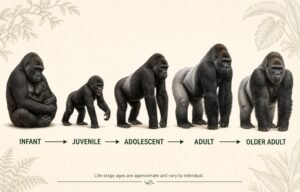
Gorilla Life Cycle: From Infancy to Adulthood
Short answer: The gorilla life cycle progresses through gestation, infancy, a juvenile period, adolescence and adulthood. Development is gradual and differs by sex, taxon and individual; labels such…