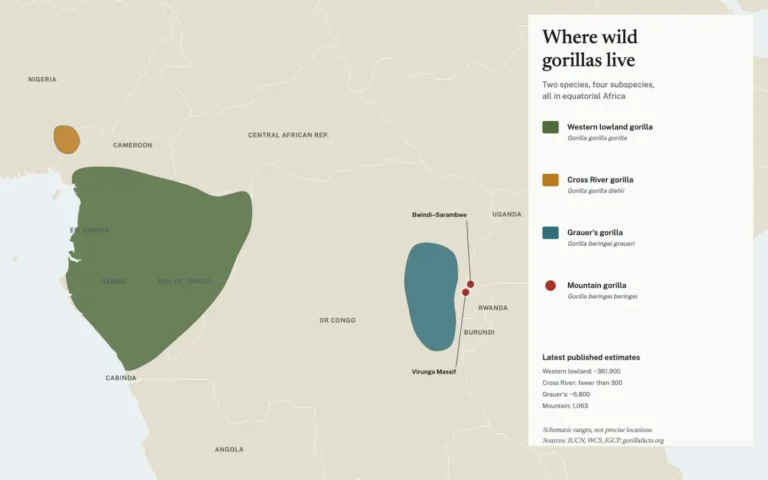
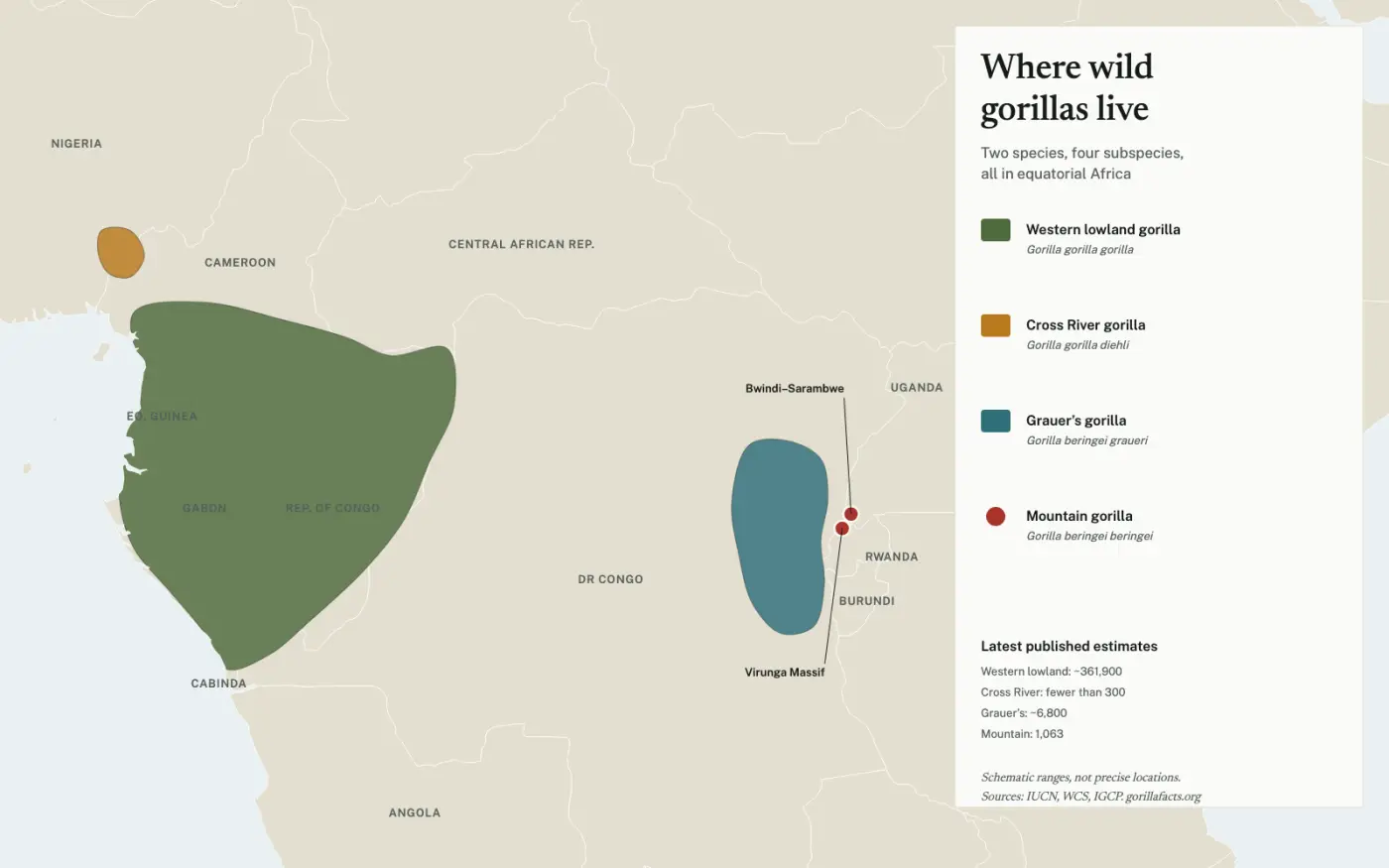
Short answer: Mountain gorillas live in two isolated transboundary landscapes in Uganda, Rwanda and the Democratic Republic of the Congo: the Virunga Massif and the Bwindi–Sarambwe ecosystem. They occur nowhere else in the wild.
The two mountain gorilla populations
1. Virunga Massif
The Virunga population moves across a connected chain of protected areas:
- Virunga National Park in the Democratic Republic of the Congo
- Volcanoes National Park in Rwanda
- Mgahinga Gorilla National Park in Uganda
International borders do not constrain gorilla movement. Groups may cross between parks as food availability, social conditions and ranging patterns change.
2. Bwindi–Sarambwe
The second population occupies Bwindi Impenetrable National Park in Uganda and the adjoining Sarambwe Nature Reserve in DRC. It is geographically isolated from the Virunga population by farms and settlements.
The International Gorilla Conservation Programme’s location guide lists the five protected areas and explains the transboundary landscape.
What is mountain gorilla habitat like?
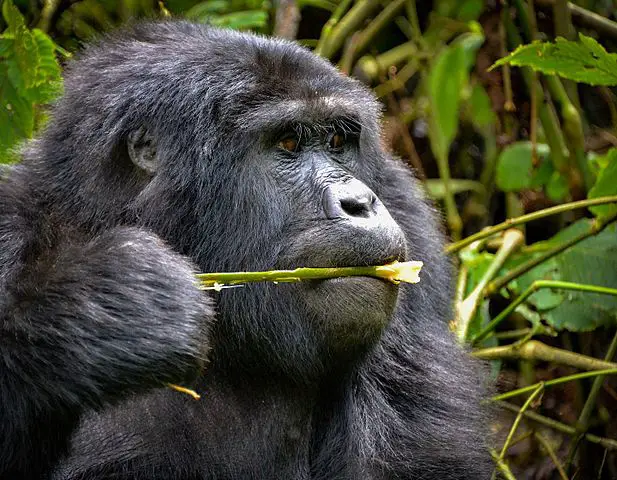
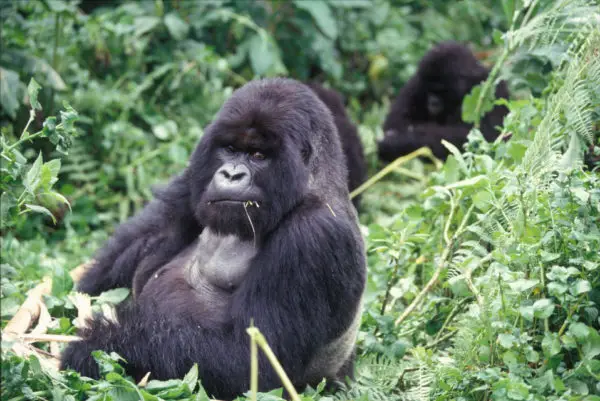
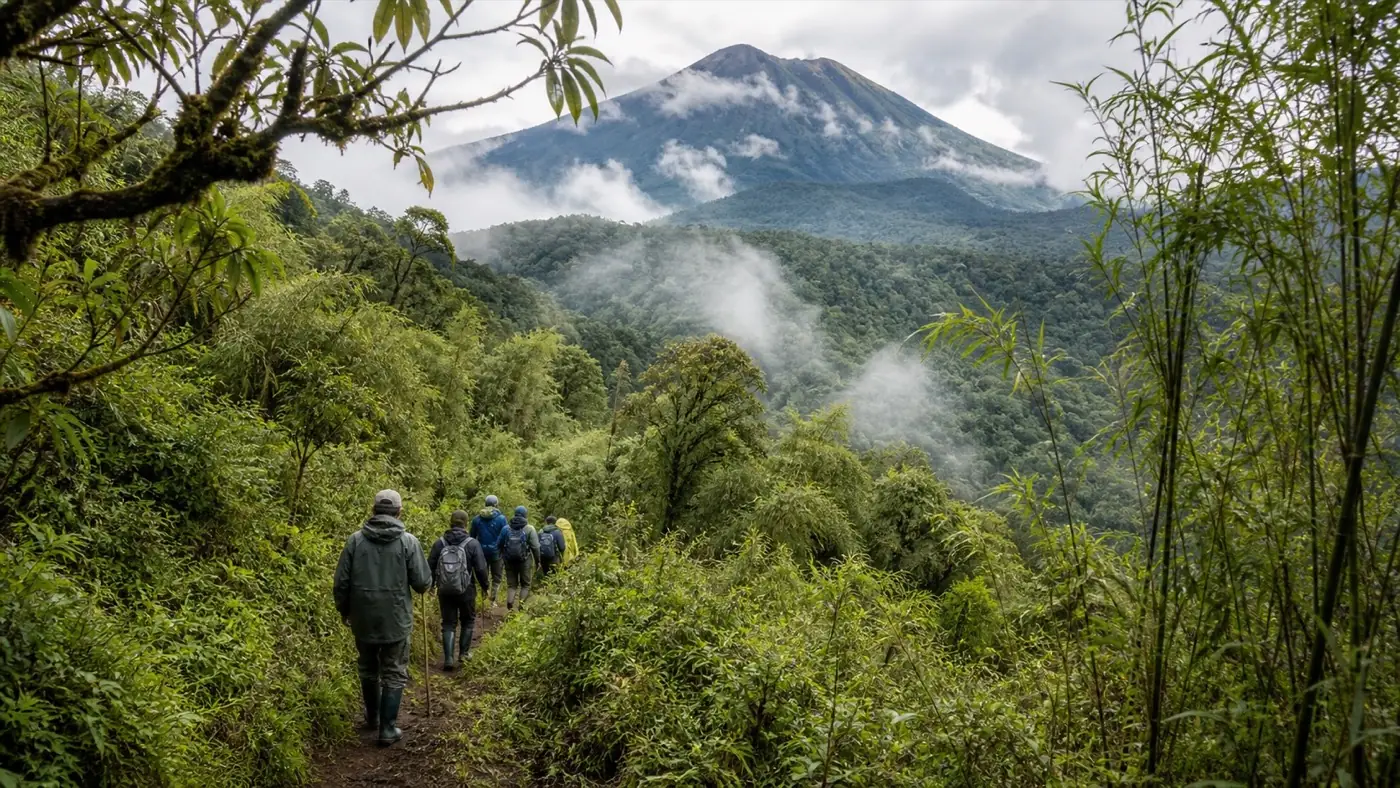
Mountain gorillas inhabit cool, moist Afromontane forests. Their habitat includes dense understory vegetation, mixed forest, bamboo zones and higher-elevation vegetation. Bwindi and the Virungas are not identical: their plant communities, elevations and seasonal food availability differ, which influences diet and ranging.
These forests also protect watersheds, store carbon and support many species found in the Albertine Rift. Conserving mountain gorillas therefore helps protect a much larger ecological community.
How large is the remaining habitat?
The habitat is extremely restricted. IUCN reported that protected areas used by mountain gorillas cover roughly 792 square kilometres across the two locations. The precise figure varies by how boundaries and connected reserves are counted. The key conservation fact is that both populations are surrounded by densely settled, cultivated landscapes and cannot simply move into unlimited forest.
Why are there only two populations?
Historical forest change and modern land conversion left the remaining mountain gorillas in two forest blocks. There is no natural forest corridor connecting Bwindi–Sarambwe with the Virunga Massif. Because the populations are isolated, each must be protected against disease outbreaks, conflict and other local shocks.
Which country has the most mountain gorillas?
Country totals are not a simple measure because groups in the Virunga Massif can cross national boundaries. Censuses are conducted cooperatively and should be interpreted by population and survey area, not as a permanent ownership tally.
Can visitors see mountain gorillas?
Regulated tourism is available in parts of the range, subject to permits and park conditions. Visitors must follow official distance, health, group-size and time limits. Rules are designed to reduce stress and the risk of transmitting human respiratory disease. Read our responsible gorilla tourism guide before considering a visit.
Threats around the habitat
- Very small and geographically restricted range
- Human-introduced infectious disease
- Snares intended for other wildlife
- Conflict and disruption of park protection
- Pressure at forest boundaries
- Climate-related changes to vegetation and disease patterns
Mountain gorillas remain Endangered despite a documented population recovery. Their improvement reflects sustained conservation, not the disappearance of risk.