Short answer: Gorillas are exceptionally powerful great apes, but science has not established a trustworthy “times stronger than a human” multiplier. Popular figures such as four, six or nine times human strength do not come from a standardized experiment in which gorillas and people performed the same task.
Last fact-checked: August 2026. This guide separates measured anatomy and observed behavior from internet estimates.
There is no scientific gorilla strength score
A valid comparison would need to control body mass, age, sex, motivation, posture, training and the exact movement being tested. Researchers cannot ethically ask a gorilla to perform a maximal bench press, deadlift or tug-of-war. Different movements also depend on different muscles and leverage, so one number could not describe every kind of strength.
This is why claims that a gorilla can lift a precise number of pounds or is a precise multiple stronger than a person should be treated as speculation unless the claim links to a reproducible study.
What researchers have measured
Body size and sexual dimorphism
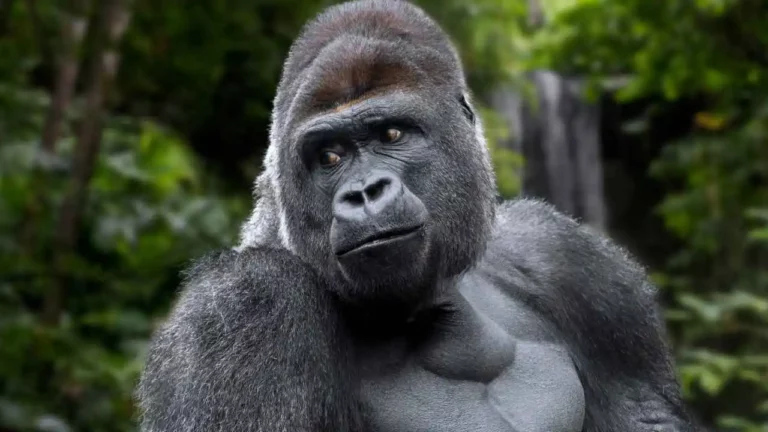
Adult male gorillas are much larger than adult females and carry substantial muscle mass. Size varies among subspecies, individuals and living conditions. A large silverback therefore has more absolute force-producing tissue than a typical adult human, but body mass alone does not yield a bench-press number.
Forelimb anatomy
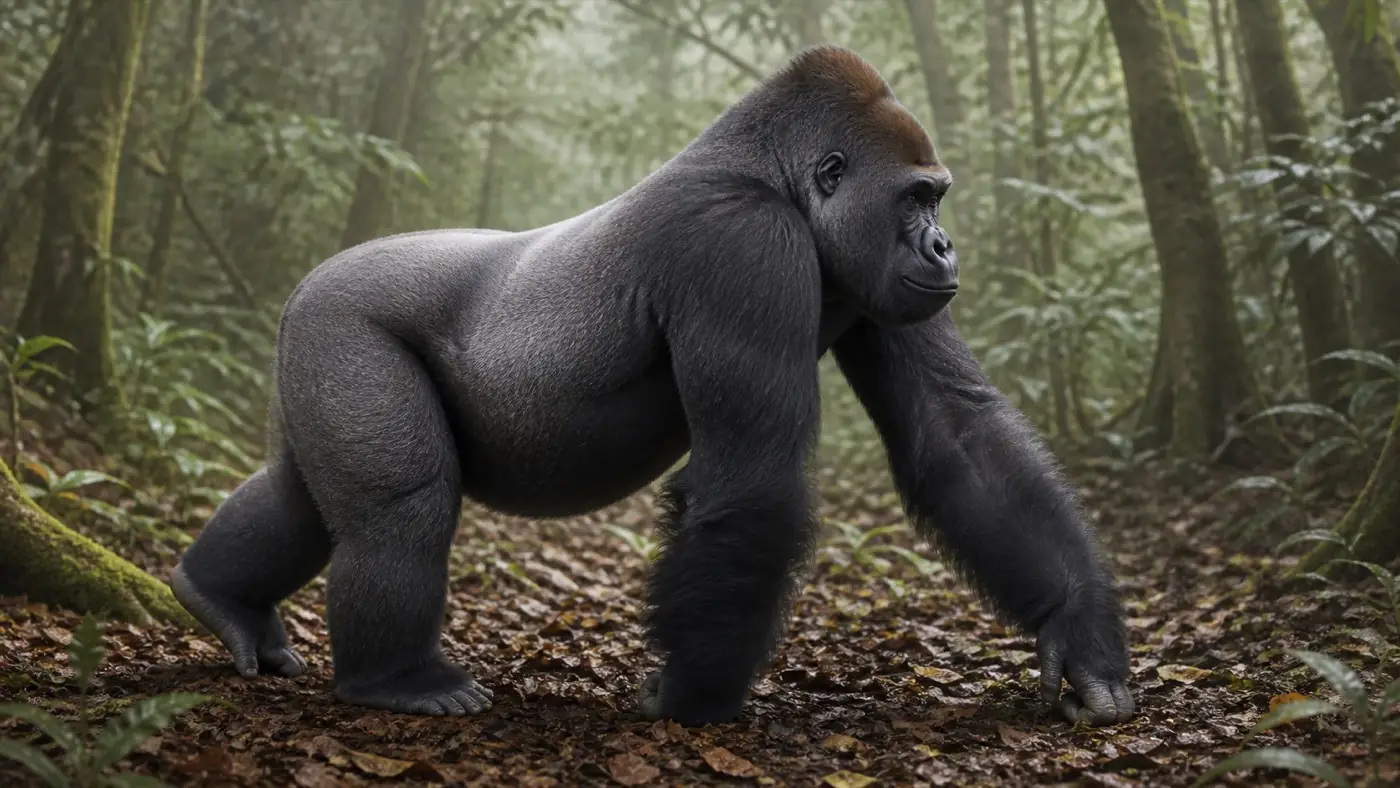
Anatomical research based on whole-body dissections found that gorilla shoulders and forelimbs combine mobility for climbing and reaching with stability during quadrupedal movement. Gorillas use their forelimbs for weight support, climbing, pulling vegetation, manipulating food and social displays. Those adaptations are real evidence of powerful upper limbs; they are not a calibrated gym performance.
Observed behavior
Wild gorillas bend and pull vegetation, climb, wrestle in play and sometimes display by dragging or striking objects. Such observations demonstrate functional strength in the animal’s natural context. They cannot be converted reliably into an exact lifting maximum because the object, angle, duration and effort are usually unknown.

Why gorillas appear so powerful
- Large bodies: adult males can be far heavier than many humans.
- Robust skeletons: their limbs and joints support a large-bodied, partly climbing ape.
- Forelimb use: gorillas routinely load the arms during knuckle-walking and use them to climb, pull and display.
- Leverage: limb proportions and joint geometry favor some movements differently from human anatomy.
These features do not mean gorillas are optimized for every human athletic task. Humans train highly specific techniques, while gorilla anatomy evolved for movement and survival in forest habitats.
Can a gorilla lift 1,800 pounds?
There is no controlled scientific measurement supporting a universal 1,800-pound lifting capacity. The claim is repeated across entertainment and animal-fact websites, often without an original experiment. Object lifting is also ambiguous: lifting from the ground, dragging, tipping and briefly shifting a load require different forces.
Is a gorilla’s bite force known?
Frequently repeated bite-force numbers are usually estimates derived from skull dimensions or unsourced compilations, not direct measurements from living gorillas. Researchers can study jaw anatomy and model mechanical performance, but an estimated value should be labeled as a model and tied to the specific paper that produced it.
Gorilla versus human comparisons
A large adult male gorilla would have an overwhelming physical advantage over an unarmed human in close contact. That conclusion does not require a fictional strength multiplier. Responsible education should not turn wildlife into fight scenarios: gorillas generally avoid conflict when they are not threatened, and safe viewing depends on distance and professional guidance.
For the narrower gym question, see could a gorilla bench press?. For measured size ranges, see gorilla weight and gorilla height.
How to evaluate a strength claim
- Look for the original study, not a chain of fact websites.
- Check whether force was measured directly or inferred from anatomy.
- Identify the animal’s species, sex, age and body mass.
- Check whether the comparison uses the same movement and conditions.
- Reject precise numbers when the method is missing.
Sources
- Zihlman, McFarland and Underwood (2011), “Functional anatomy and adaptation of male gorillas”, Anatomical Record, doi:10.1002/ar.21449.
- Wright et al. (2021), “Chest beats as an honest signal of body size in male mountain gorillas”, Scientific Reports.
- Smithsonian’s National Zoo, western lowland gorilla biology.