
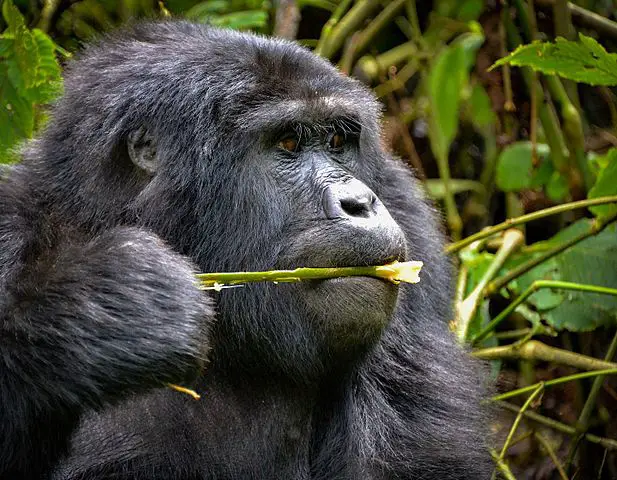
Short answer: Mountain gorillas mainly eat leaves, stems, shoots and pith from terrestrial plants. They also eat bark, roots, flowers and fruit when available. Diet differs between the high-elevation Virunga Massif and Bwindi, where a greater diversity of fruit is available.
Last fact-checked: August 2026. This guide describes observed diets; it does not use a simplistic “food chain” for poachers or predators.
Mountain gorilla feeding habitats
Mountain gorillas occur in two landscapes: the Virunga Massif, shared by Rwanda, Uganda and the Democratic Republic of the Congo, and the Bwindi–Sarambwe landscape in Uganda and the DRC. Differences in elevation and vegetation mean the two populations do not encounter identical foods.
Virunga gorillas rely heavily on abundant terrestrial herbs. Bwindi gorillas also consume many fibrous plant parts but have access to more fruit. Researchers therefore report diets by site and season rather than treating the subspecies as one feeding study.
Main foods
- Leaves: selected from particular herbs, shrubs and trees.
- Stems and shoots: young or otherwise edible growth from terrestrial vegetation.
- Pith: the softer internal tissue of selected stems.
- Bark and roots: eaten from certain plant species, not indiscriminately.
- Fruit: more important where and when fruiting plants are available, especially in Bwindi.
- Occasional invertebrates: small amounts may be consumed, but plants dominate the diet.
Gorillas select foods rather than eating every plant
Field researchers combine direct observation with vegetation sampling and laboratory analysis. A study of four Bwindi groups found that gorillas generally preferred leaves with relatively high protein and lower fiber, and pith with relatively high sugar. Preference means a food is selected more than expected from its availability; it does not imply one nutrient explains every choice.
Plant chemistry, digestibility, abundance, handling time and learned behavior can all influence selection. Results from one forest or social group should not be generalized automatically to all mountain gorillas.
How season changes the diet
When fruit intake rises, the nutrient balance changes: research in Bwindi found lower dietary concentrations of protein and fiber and higher water-soluble carbohydrates during more fruit-rich periods. Energy intake did not necessarily increase. Gorillas adjusted the amount and composition of food consumed.
Seasonal variation is one reason unsourced statements such as “a gorilla eats exactly X kilograms of leaves every day” are unreliable.
How mountain gorillas process fibrous food
Gorillas chew plant material with large molars and rely on microbes in the hindgut to ferment structural carbohydrates. Fermentation produces compounds the body can use for energy. This digestive strategy supports a bulky, high-fiber diet but does not mean gorillas can safely eat any plant.
How feeding shapes daily life
Mountain gorillas travel between food patches, feed for substantial portions of the day, rest and build nests. The abundance of terrestrial herbs can allow groups to use smaller daily ranges than more fruit-dependent apes, although neighbors, group size and local habitat also affect movement.
Do mountain gorillas have natural predators?
Ecological food webs are more complex than a single chain. Adult mountain gorillas face little routine predation, although leopards have been discussed as potential or historical predators of gorillas in some regions. Humans are not a natural “next link” in a gorilla food chain: illegal killing is a conservation threat caused by human activity.
Why diet matters for conservation
Protecting mountain gorillas requires protecting the diversity and continuity of their feeding habitat. Agriculture, settlement, snares, invasive plants and climate-driven vegetation changes can affect food availability or safe movement. Tourism must also be managed to reduce stress and disease transmission while funding protection.
Compare this diet with gorilla diets across all four subspecies, and learn where mountain gorillas live.
Sources
- Ganas, Ortmann and Robbins (2008), “Food preferences of wild mountain gorillas”, American Journal of Primatology.
- Rothman et al. (2008), “Nutritional quality of gorilla diets”, Oecologia.
- Rothman et al. (2011), “Nutritional geometry: gorillas prioritize non-protein energy”, Biology Letters.
- International Gorilla Conservation Programme, mountain gorilla conservation and range.