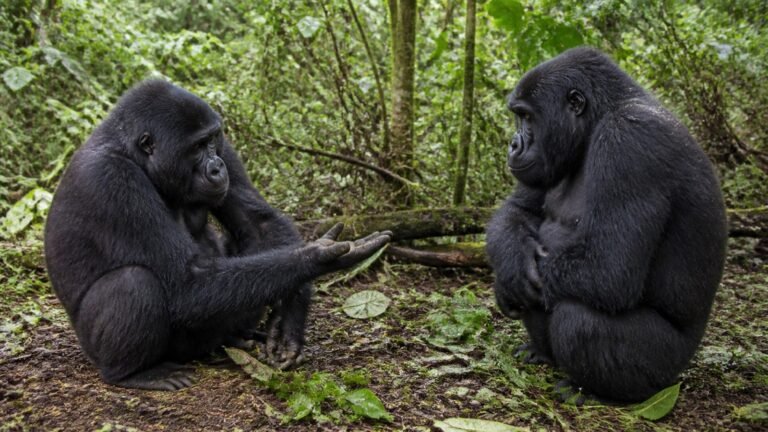
Short answer: Gorilla chest beating is a visual and acoustic signal. Research on wild mountain gorillas shows that larger adult males produce lower-frequency chest beats, so the sound can communicate body size. Chest beats may help gorillas assess rivals, attract mates and manage encounters without immediate physical fighting.
Last fact-checked: August 2026. Findings about signal content are separated below from hypotheses that still need testing.
How gorillas make the chest-beating sound
A gorilla usually rises into a bipedal position and rapidly strikes its chest with alternating, cupped hands. The cupped shape helps produce the resonant drumming sound. The display may also include hooting, running, vegetation striking or other movements, but the sequence varies.
Chest beating is not a vocalization: the principal sound comes from the hands striking the body. Because observers can both see and hear it, researchers describe it as a multimodal signal. In dense forest, its acoustic component is especially useful because vegetation can block a clear view.
Chest beats communicate body size
A 2021 study recorded wild adult male mountain gorillas in Volcanoes National Park, Rwanda. Across 3,211 hours of focal observation, researchers recorded 503 chest beats from 25 males and analyzed suitable audio recordings alongside measurements of back breadth.
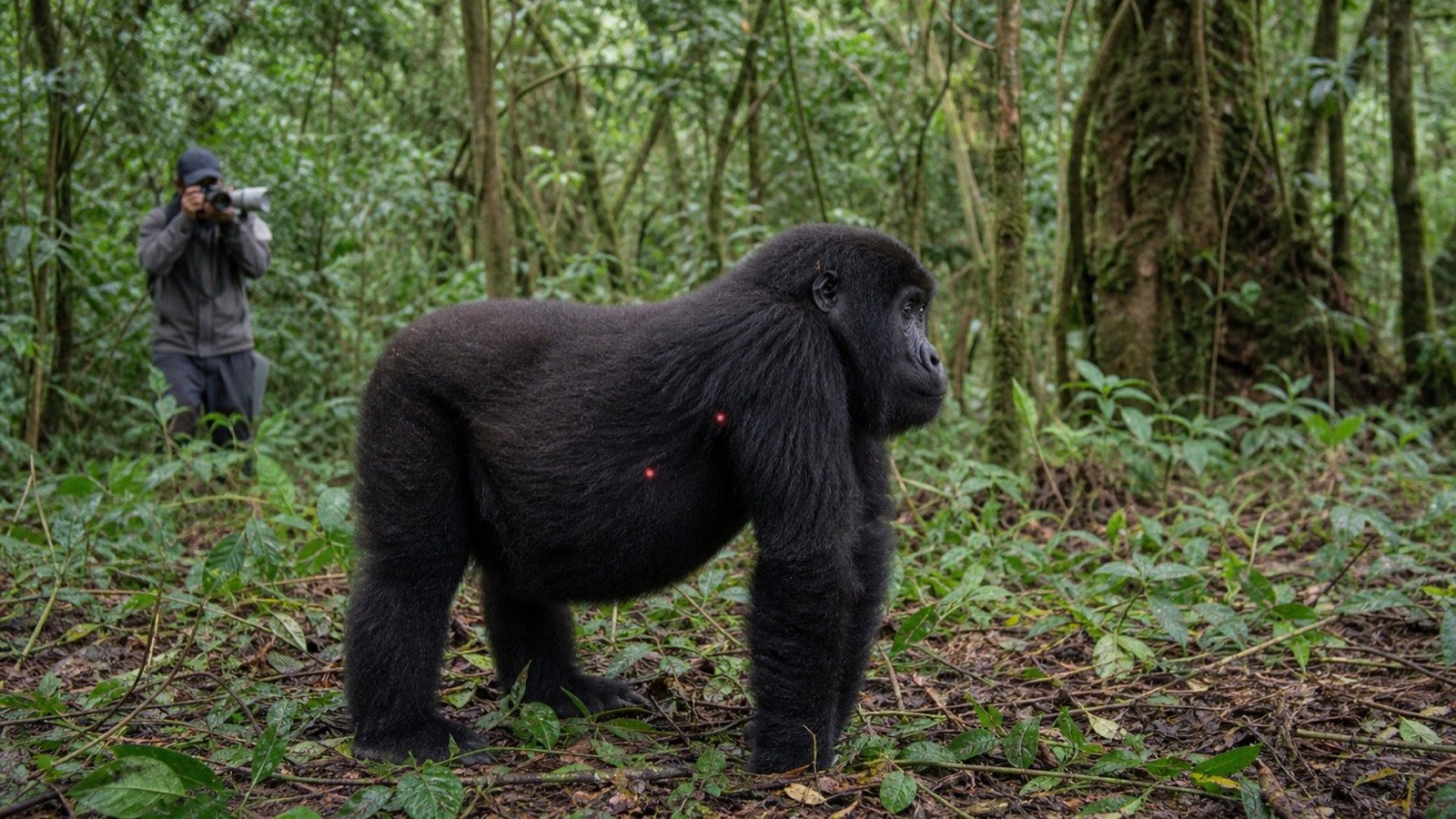
Larger males produced chest beats with lower peak frequencies. The researchers therefore concluded that the signal reliably conveys information about body size, a trait related to competitive ability in adult males.
The study did not find a consistent relationship between body size and chest-beat duration, number of beats or beat rate. A deeper sound—not simply a longer or faster display—was the measured indicator.
Why body-size information matters
Avoiding costly fights
Adult males can use long-distance signals to assess other males before approaching. If the sound indicates a very large rival, withdrawal may be safer than escalation. Researchers propose that this signaling can help resolve competition without frequent contact aggression.

Mate choice
Previous observations found that silverbacks chest beat more often when females were in estrus. Combined with evidence that chest-beat frequency signals male size, this supports a possible role in mate assessment. It does not mean every chest beat is directed at a potential mate.
Spacing between groups
Chest beats can travel through forest over long distances. Researchers have proposed that they help groups monitor neighboring gorillas and influence movement. The exact responses of listeners still require more direct testing.
Do only silverbacks beat their chests?
No. Adult males produce the best-known and most powerful displays, but females and younger gorillas can also chest beat. Young gorillas may perform the behavior during play. The meaning depends on the individual and the surrounding social situation.
Does every gorilla have a unique chest beat?
The 2021 research found variation among individuals, but it did not establish that listeners recognize every gorilla by an individual acoustic “signature.” The authors identified individual recognition as a question for future study. It is therefore premature to state as fact that every chest beat functions like a name.
Is chest beating always aggressive?
No. It can occur during competition and high-arousal displays, but it also occurs in play and other contexts. Describing every chest beat as anger misses its role as communication. Safe interpretation requires the full behavioral sequence, the identity and age of the gorilla, and the social context.
What remains unknown
- How listeners change their behavior in response to the body-size information
- Whether chest beats reliably encode individual identity
- How signal use differs among species, populations, ages and sexes
- Which anatomical features most strongly determine the sound frequency
Explore more in types of gorillas and what science says about gorilla strength.
Sources
- Wright et al. (2021), “Chest beats as an honest signal of body size in male mountain gorillas”, Scientific Reports, doi:10.1038/s41598-021-86261-8.
- Salmi et al. (2020), “The context of chest beating and hand clapping in wild western gorillas”, Primates.
- Roberts et al. (2017), great ape gesture repertoire research, Animal Cognition.