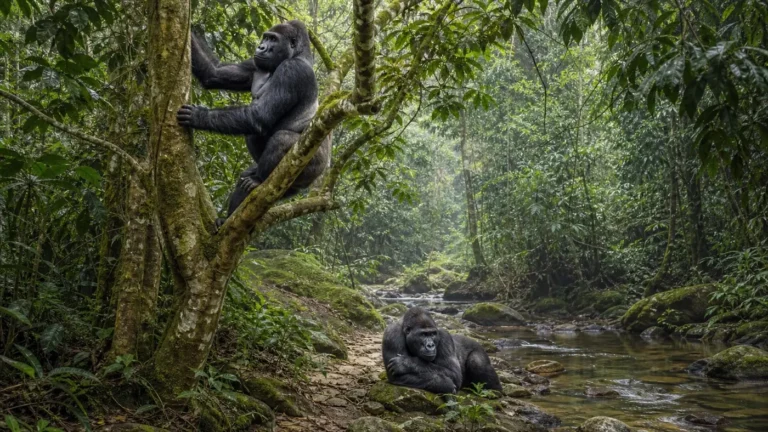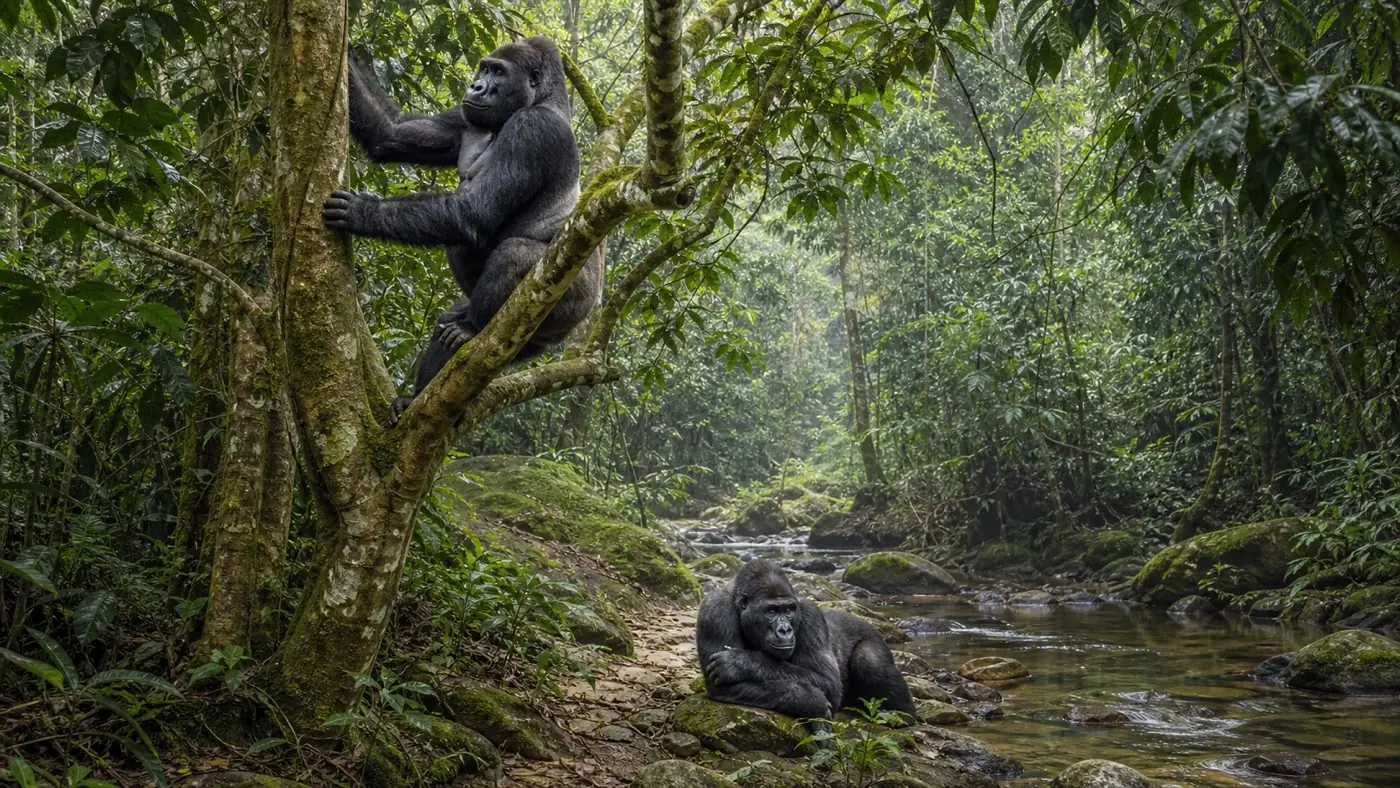
Short answer: Gorillas can climb trees. Youngsters usually climb more often, while heavy adults favor large supports and ground travel. A detailed study of wild western lowland gorillas documented walking, vertical climbing, suspension and gap-crossing in the canopy.
Why the “ground-dwelling” label is incomplete
Gorillas are more terrestrial than orangutans, yet they still exploit arboreal foods and sleeping sites. The balance depends on taxon, habitat, fruit availability, age and sex. A mountain silverback in herb-rich vegetation faces different opportunities from an adolescent western gorilla tracking fruit.
What 944 hours of observation revealed
A recent study at Loango National Park recorded 56,635 positional observations. When gorillas moved in trees, walking accounted for about 44 percent of arboreal locomotion and vertical climbing about 36 percent. Suspension and gap-crossing were less common but clearly part of the repertoire.
Height changes the problem
More than half of arboreal movement occurred below 10 metres, and movement became less common above 20 metres. Gorillas generally selected supports capable of carrying them, yet flexible branches and lianas could be combined during suspension.
Silverbacks can climb
Large adult males were the least arboreally mobile age–sex class in the study, not completely ground-bound. They used conservative routes, substantial supports and careful descents. Body mass changes risk rather than switching climbing ability off.
Why youngsters look like aerial acrobats
Lower mass makes thinner supports usable and falls less energetically dangerous. Play also gives juveniles repeated practice with balance, suspension and route choice. Their movement is development as well as entertainment.
Do gorillas sleep in trees?
They may build nests on the ground or in vegetation. Adult males commonly nest on the ground, while females and young are more likely to nest above it. Local plant structure and individual preference matter.