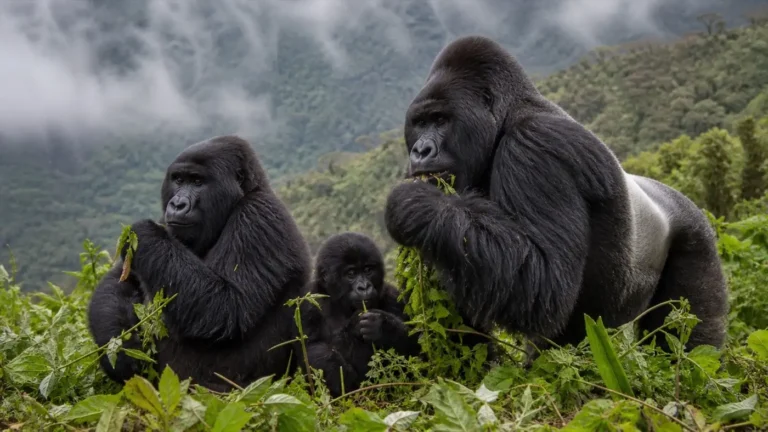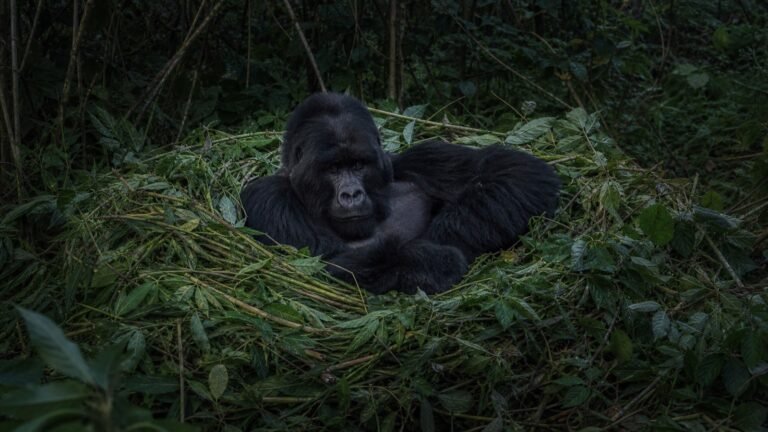
Short answer: Gorillas mate within a complex social system. Adult females can initiate sexual behavior, choose which group to join and transfer between males. A dominant silverback may sire many infants, but reproductive outcomes reflect relationships, competition and group composition.
There is no fixed breeding season
Births occur throughout the year. Female reproductive cycles are not advertised by the conspicuous swellings seen in chimpanzees. Receptivity may be expressed through proximity, gaze, posture and initiation.
Female choice starts before mating
Females commonly leave their birth group and choose another group or solitary male. A male’s size, protection, relationships and group situation may influence the decision. A female can transfer again later, showing that group membership is not permanent ownership.
What dominant means—and does not mean
In one-male groups, the resident silverback often sires the offspring. Multi-male mountain gorilla groups can include mating by subordinate males, with outcomes shaped by rank and kinship. “Dominant” describes a relationship within a group, not absolute control over every interaction.
Courtship can be subtle
Initiation may involve sustained attention, approach and positioning rather than dramatic display. Some vocal behavior occurs during copulation. Because wild mating is brief and visibility can be poor, published descriptions depend strongly on habituated groups.
Why females transfer
- Approaching maturity
- Loss or weakening of a resident male
- Opportunities during intergroup encounters
- Protection from infanticide
- Social preference or changing group conditions
Mating and infant survival are linked
A male takeover can place unrelated infants at risk of infanticide. Females may respond through transfer, protective association or mating patterns that confuse paternity. Evolutionary explanations describe population-level consequences; they do not mean gorillas calculate genetic payoffs.
What happens after conception?
Maternal investment dominates: pregnancy lasts roughly eight and a half months and dependence continues for years. Males can protect and affiliate with infants, but mothers provide gestation, nursing and most transport.