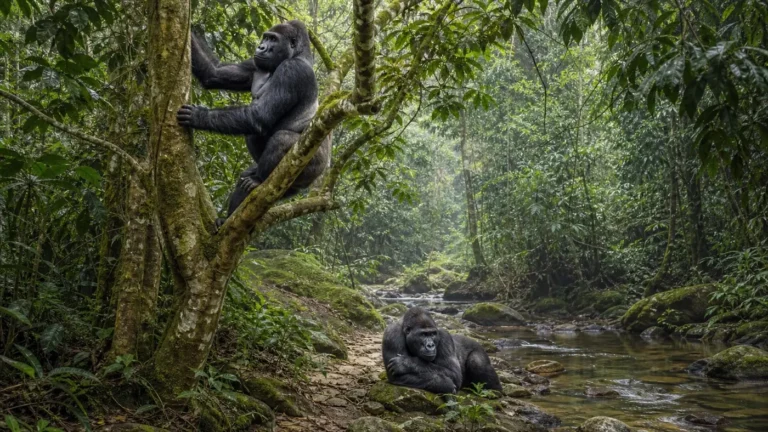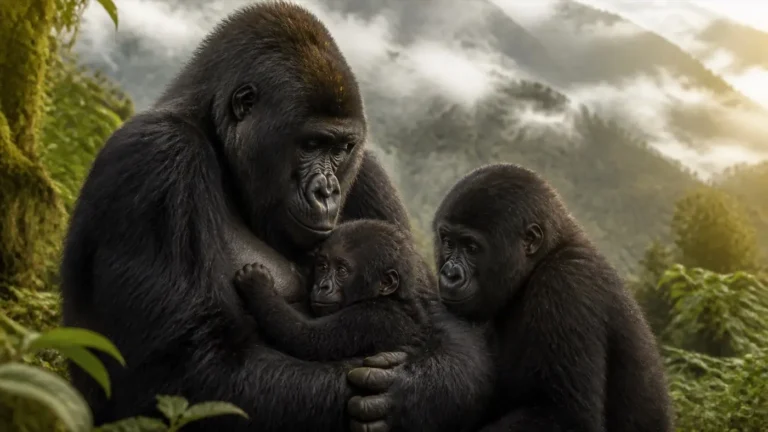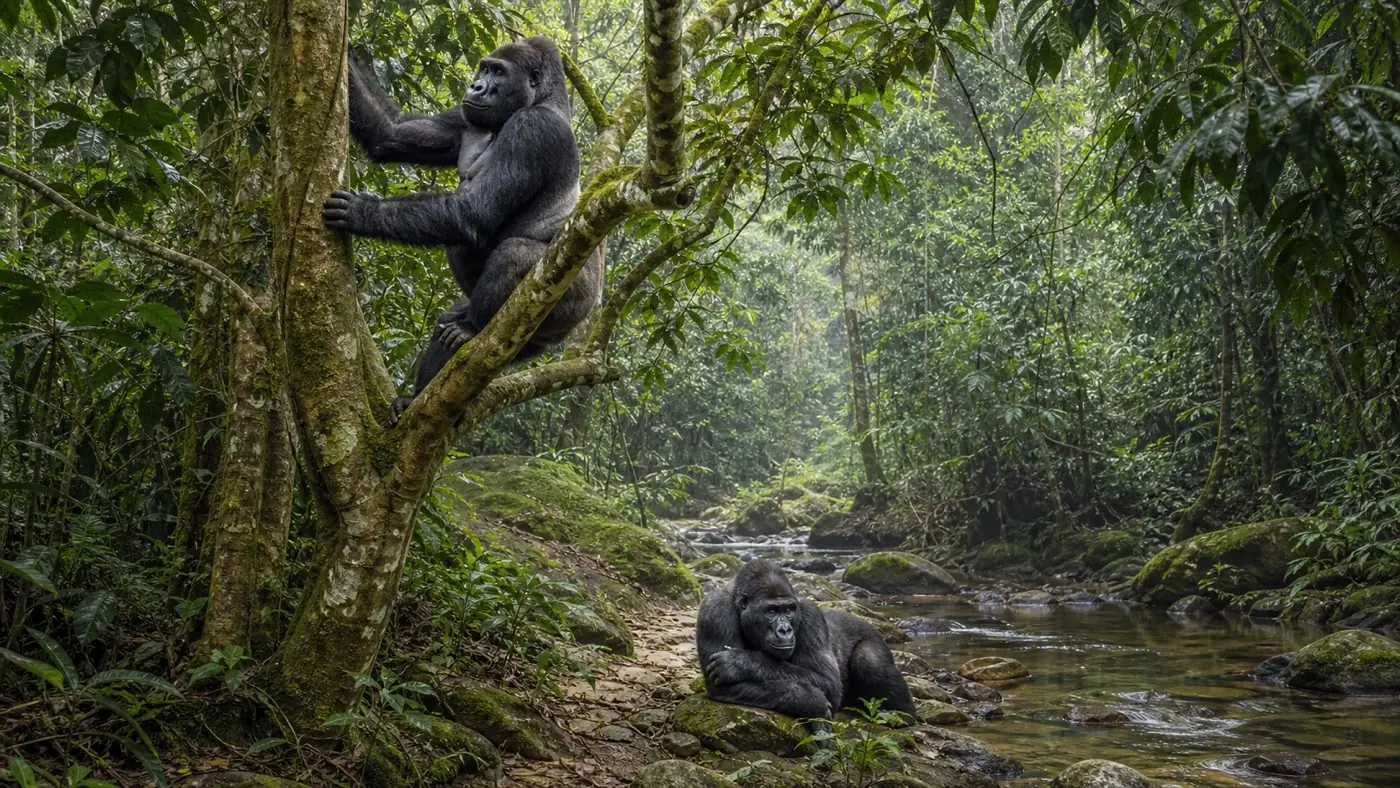
Short answer: Gorillas are not known to swim habitually in the wild, and many avoid deep water. That is different from proving that no gorilla could paddle under any circumstance. The strongest evidence concerns wading, testing depth and navigating swamps—not controlled swimming performance.
Why the question is difficult to test
Ethical researchers do not place gorillas in deep water to see what happens. Wild encounters with rivers are unpredictable, and dense forest limits observation. Zoo moats historically demonstrated water avoidance but are not standardized experiments.
Wild gorillas do enter shallow water
Western lowland gorillas use swamp forests and forest clearings. At Mbeli Bai, an adult female was observed using a branch to test water depth and support herself while crossing. Another used vegetation as a stabilizer and bridge. The behavior shows caution and problem-solving, not helplessness around all water.
Swimming and wading are different
Wading keeps the feet or hands in contact with the bottom. Swimming requires buoyancy and propulsion without support. Photographs of a chest-deep gorilla do not establish sustained swimming, just as avoiding a moat does not prove anatomical impossibility.
Why body composition matters—but does not settle it
Dense muscle and relatively low body fat may reduce passive buoyancy compared with many humans, while limb proportions and habitual locomotion are not specialized for efficient swimming. Still, behavior, experience and water conditions matter. Anatomy supports a cautious expectation, not an absolute law.
Do gorillas drink water?
They obtain much moisture from plant foods but may drink from pools, streams or vegetation. Drinking behavior varies with habitat and season. The claim that gorillas “never drink” is too strong.
Visitor safety around water
Never use water as a barrier you assume a wild animal cannot cross. Maintain official distances and follow staff instructions in parks and accredited zoos. Wildlife behavior is not a party trick to test.
Evidence verdict
- Shallow-water use and wading: documented.
- Tool-assisted water crossing: documented.
- Routine wild swimming: not established.
- Absolute inability to swim: not ethically demonstrated.