
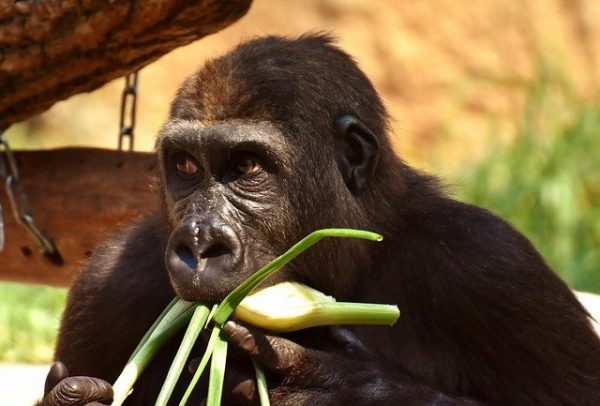
Short answer: Gorillas eat predominantly plant foods—including leaves, stems, shoots, pith, bark and fruit—but the balance varies by species, habitat and season. Western gorillas generally eat more fruit when it is available, while mountain gorillas rely heavily on terrestrial herbs. Some populations also consume ants or termites.
Last fact-checked: August 2026. Percentages from one field site should not be assumed to describe every gorilla population.
Gorillas do not all eat the same diet
Four gorilla subspecies occupy forests that differ in elevation, plant communities and fruit availability. Diet also changes across seasons and even between neighboring social groups. “What gorillas eat” therefore has no single universal menu.
| Gorilla | Commonly documented foods | Important variation |
|---|---|---|
| Western lowland | Fruit, leaves, stems, bark and some insects | Fruit intake rises and falls with availability; different groups may select different foods. |
| Cross River | Fruit and fibrous vegetation | Direct observation is limited because the population is rare and wary. |
| Grauer’s | Leaves, pith, bark, stems and fruit | Diet varies across its large elevation range and among populations. |
| Mountain | Leaves, stems, shoots and pith; fruit where available | Bwindi offers more fruit than the high-elevation Virungas. |
Leaves, stems, shoots and pith
Fibrous vegetation is a dependable part of gorilla diets. Gorillas select particular plant species and parts rather than eating leaves indiscriminately. Research on mountain gorillas found preferences associated with features such as relatively high protein or sugar and lower fiber in certain plant parts.
A large gut and microbial fermentation help gorillas obtain energy from fibrous plant material. This does not make every plant safe or nutritious, and it should not be used as a model for a human diet.
Fruit and seasonal change
Western lowland gorillas can be strongly frugivorous when ripe fruit is available. One field-study review reported fruit as a major dietary component at studied sites, while emphasizing that the evidence came from a limited area and may not represent the entire subspecies.
When fruit becomes scarce, western gorillas increase their reliance on leaves and other fibrous foods. Mountain gorillas in Bwindi also eat fruit, but fruit is much less available in the high-altitude Virunga habitat. Seasonal percentages only make sense when tied to a site and observation period.
Do gorillas eat insects or meat?
Gorillas are predominantly herbivorous, but “strict herbivore” can be misleading. Western gorillas have been observed consuming ants and termites, and small invertebrates may also be eaten incidentally with plants. There is no evidence that hunting vertebrate prey is a normal, important part of wild gorilla feeding ecology.
That distinction matters: occasional insect consumption does not make gorillas ecologically similar to chimpanzees, which have well-documented cooperative hunting in some populations.
How much does a gorilla eat?
Daily intake depends on body size, age, sex, food water content, season and how researchers measure wet versus dry mass. Exact daily-pound figures repeated online often omit those conditions. It is safer to say that a large gorilla spends many hours selecting and processing bulky plant foods than to assign every animal one daily amount.
What do gorillas drink?
Wild gorillas obtain substantial water from moist vegetation and fruit. They can drink open water, but the frequency varies by habitat and diet. Claims that gorillas “never drink water” are too absolute.
Captive gorilla diets
Accredited zoos design diets with veterinary and nutrition teams. Typical programs emphasize leafy vegetables and other high-fiber foods, with controlled quantities of fruit and specialized primate feeds where appropriate. A zoo diet should not copy an old display menu or a percentage from another institution; it is adjusted for individual health, activity and husbandry.
Visitors should never feed gorillas. Human snack foods can disrupt nutrition, and close contact creates behavioral and disease risks.
Diet and conservation
Gorilla survival depends on a landscape that supplies foods across seasons. Forest clearance can remove fruiting trees, terrestrial herbs and travel routes simultaneously. Protecting only a sleeping site is not enough if feeding habitat and connections between forest patches disappear.
For a closer look at high-elevation feeding, read what mountain gorillas eat. See also gorilla habitats and the four gorilla subspecies.
Sources
- Rothman et al. (2008), “Nutritional quality of gorilla diets”, Oecologia, doi:10.1007/s00442-007-0901-1.
- Ganas, Ortmann and Robbins (2008), “Food preferences of wild mountain gorillas”, American Journal of Primatology.
- Head et al. (2022), “Dietary variability of western gorillas”, PLOS ONE.
- Rothman et al. (2011), gorilla nutritional geometry, Biology Letters.
- Smithsonian’s National Zoo, western lowland gorilla care and biology.